By Danielle Dellorto, Senior Medical Producer
June 1, 2010 -- Updated 0531 GMT (1331 HKT)
(CNN) -- If you're eating non-organic celery today, you may be ingesting 67 pesticides with it, according to a new report from the Environmental Working Group.
The group, a nonprofit focused on public health, scoured nearly 100,000 produce pesticide reports from the U.S. Department of Agriculture and the U.S. Food and Drug Administration to determine what fruits and vegetables we eat have the highest, and lowest, amounts of chemical residue.
Most alarming are the fruits and vegetables dubbed the "Dirty Dozen," which contain 47 to 67 pesticides per serving. These foods are believed to be most susceptible because they have soft skin that tends to absorb more pesticides.
"It's critical people know what they are consuming," the Environmental Working Group's Amy Rosenthal said. "The list is based on pesticide tests conducted after the produce was washed with USDA high-power pressure water system. The numbers reflect the closest thing to what consumers are buying at the store."
Special report: Toxic America
The group suggests limiting consumption of pesticides by purchasing organic for the 12 fruits and vegetables.
"You can reduce your exposure to pesticides by up to 80 percent by buying the organic version of the Dirty Dozen," Rosenthal said.
The Dirty Dozen
Celery
Peaches
Strawberries
Apples
Domestic blueberries
Nectarines
Sweet bell peppers
Spinach, kale and collard greens
Cherries
Potatoes
Imported grapes
Lettuce
Not all non-organic fruits and vegetables have a high pesticide level. Some produce has a strong outer layer that provides a defense against pesticide contamination. The group found a number of non-organic fruits and vegetables dubbed the "Clean 15" that contained little to no pesticides.
The Clean 15
Onions
Avocados
Sweet corn
Pineapples
Mango
Sweet peas
Asparagus
Kiwi fruit
Cabbage
Eggplant
Cantaloupe
Watermelon
Grapefruit
Sweet potatoes
Sweet onions
What is a pesticide?
A pesticide is a mixture of chemical substances used on farms to destroy or prevent pests, diseases and weeds from affecting crops. According to the USDA, 45 percent of the world's crops are lost to damage or spoilage, so many farmers count on pesticides.
The Environmental Protection Agency, the FDA and the USDA work together to monitor and set limits as to how much pesticide can be used on farms and how much is safe to remain on the produce once it hits grocery store shelves.
"In setting the tolerance amount, the EPA must make a safety finding that the pesticide can be used with 'reasonable certainty of no harm.' The EPA ensures that the tolerance selected will be safe," according the EPA's website.
Although the President's Cancer Panel recently recommended that consumers eat produce without pesticides to reduce their risk of getting cancer and other diseases, the low levels of pesticides found on even the Dirty Dozen are government-approved amounts.
Can small amounts of pesticides hurt you?
The government says that consuming pesticides in low amounts doesn't harm you, but some studies show an association between pesticides and health problems such as cancer, attention-deficit (hyperactivity) disorder and nervous system disorders and say exposure could weaken immune systems.
The Environmental Working Group acknowledges that data from long-term studies aren't available but warns consumers of the potential dangers.
"Pesticides are designed to kill things. Why wait for 20 years to discover they are bad for us?" Rosenthal said.
Some doctors warn that children's growing brains are the most vulnerable to pesticides in food.
"A kid's brain goes through extraordinary development, and if pesticides get into the brain, it can cause damage," said Dr. Philip Landrigan, chairman of the department of preventive medicine at Mount Sinai School of Medicine in New York.
Can pesticides be washed away?
Not necessarily. The pesticide tests mentioned above were conducted after the food had been power-washed by the USDA. Also, although some pesticides are found on the surface of foods, other pesticides may be taken up through the roots and into the plant and cannot be removed.
"We've found that washing doesn't do much," Rosenthal said. "Peeling can help, although you have to take into account that the pesticides are in the water, so they can be inside the fruit because of the soil."
All fresh produce, whether it's grown with or without pesticides, should be washed with water to remove dirt and potentially harmful bacteria. And health experts agree that when it comes to the Dirty Dozen list, choose organic if it's available.
"To the extent you can afford to do so, [parents] should simply buy organic, because there have been some very good studies that shows people who eat mostly organic food reduce 95 percent of pesticides [in their body] in two weeks," Landrigan said.

Showing posts with label organic food. Show all posts
Showing posts with label organic food. Show all posts
Tuesday, June 8, 2010


A TALE OF TWO CALVES — ONE CALF WAS FED ON RAW MILK, THE OTHER ON PASTEURIZED
JUNE 4, 2010...8:33 AM
http://thebovine.wordpress.com/2010/06/04/the-tale-of-two-calves-one-calf-got-raw-milk-the-other-pasteurized/
Here are the preliminary results (June 3), as reported by Michael Schmidt:

Raw milk fed calf
To understand the results of our raw milk experiment it is important to tolerate the so called scientific demands. That means in order to get accepted and being taken seriously by the scientific establishment you need to have 100 or 200 or 300 or may be even 1000 calves to make a scientific valid point .However the simple fact that the so called experts have not yet entered into a joint research project as proposed by me already in 1994 has given me even a greater confidence that the results we have seen with these two calves are credible and significant. They are in fact supporting the findings of Pottenger’s cat study, which as well has been ignored and ridiculed.

Calf fed on pasteurized milk diet
The experiment was costing us over 5000 dollars just in milk. This is a significant amount for us, since we did not get any support from corporate sponsors.
The weight of the two calves was basically equal at the beginning of the feeding trial.
At the end the raw milk calf weight 200 kg and the pasteurized milk calf weight 115 kg.
They gained weight almost equally for about 8 weeks and then the pasteurized milk calf started falling back.
A significant difference during the 4 month trial was always the different smell and the consistency of the manure. The raw milk calf had mostly a well formed manure and normal smell you would expect. Contrary to that the manure of the pasteurized calf was runny and the color mostly grey or almost white during the feeding trial.
We did not treat either of these calves for any condition. We would have if there would have been a life threatening situation.
The hair on the raw milk calf was shiny and solid on the pasteurized calf dull and easily pulled out.
The alertness in the two calves was a major difference: the pasteurized calf seemed very uninterested with a clear lack of movement.
After nearly 5 months we could see that the pasteurized calf would have had difficulty to survive without medication and supplements.
Below are some of the pictures to show the obvious visual differences.

Livers: Pasteurized on the left, Raw on the right

A tale of two stomachs -- in the cart raw milk stomach with solid contents, and on the floor the stomach from the calf which was fed on pasteurised milk, with very bad smelling runny contents
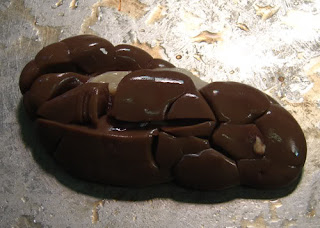
Raw kidney

Kidney from pasteurized milk fed calf

Testes of pasteurized milk fed calf

Testes of raw milk fed calf
http://thebovine.wordpress.com/2010/06/04/the-tale-of-two-calves-one-calf-got-raw-milk-the-other-pasteurized/
Here are the preliminary results (June 3), as reported by Michael Schmidt:

Raw milk fed calf
To understand the results of our raw milk experiment it is important to tolerate the so called scientific demands. That means in order to get accepted and being taken seriously by the scientific establishment you need to have 100 or 200 or 300 or may be even 1000 calves to make a scientific valid point .However the simple fact that the so called experts have not yet entered into a joint research project as proposed by me already in 1994 has given me even a greater confidence that the results we have seen with these two calves are credible and significant. They are in fact supporting the findings of Pottenger’s cat study, which as well has been ignored and ridiculed.

Calf fed on pasteurized milk diet
The experiment was costing us over 5000 dollars just in milk. This is a significant amount for us, since we did not get any support from corporate sponsors.
The weight of the two calves was basically equal at the beginning of the feeding trial.
At the end the raw milk calf weight 200 kg and the pasteurized milk calf weight 115 kg.
They gained weight almost equally for about 8 weeks and then the pasteurized milk calf started falling back.
A significant difference during the 4 month trial was always the different smell and the consistency of the manure. The raw milk calf had mostly a well formed manure and normal smell you would expect. Contrary to that the manure of the pasteurized calf was runny and the color mostly grey or almost white during the feeding trial.
We did not treat either of these calves for any condition. We would have if there would have been a life threatening situation.
The hair on the raw milk calf was shiny and solid on the pasteurized calf dull and easily pulled out.
The alertness in the two calves was a major difference: the pasteurized calf seemed very uninterested with a clear lack of movement.
After nearly 5 months we could see that the pasteurized calf would have had difficulty to survive without medication and supplements.
Below are some of the pictures to show the obvious visual differences.

Livers: Pasteurized on the left, Raw on the right

A tale of two stomachs -- in the cart raw milk stomach with solid contents, and on the floor the stomach from the calf which was fed on pasteurised milk, with very bad smelling runny contents

Raw kidney

Kidney from pasteurized milk fed calf

Testes of pasteurized milk fed calf

Testes of raw milk fed calf
Subscribe to:
Posts (Atom)